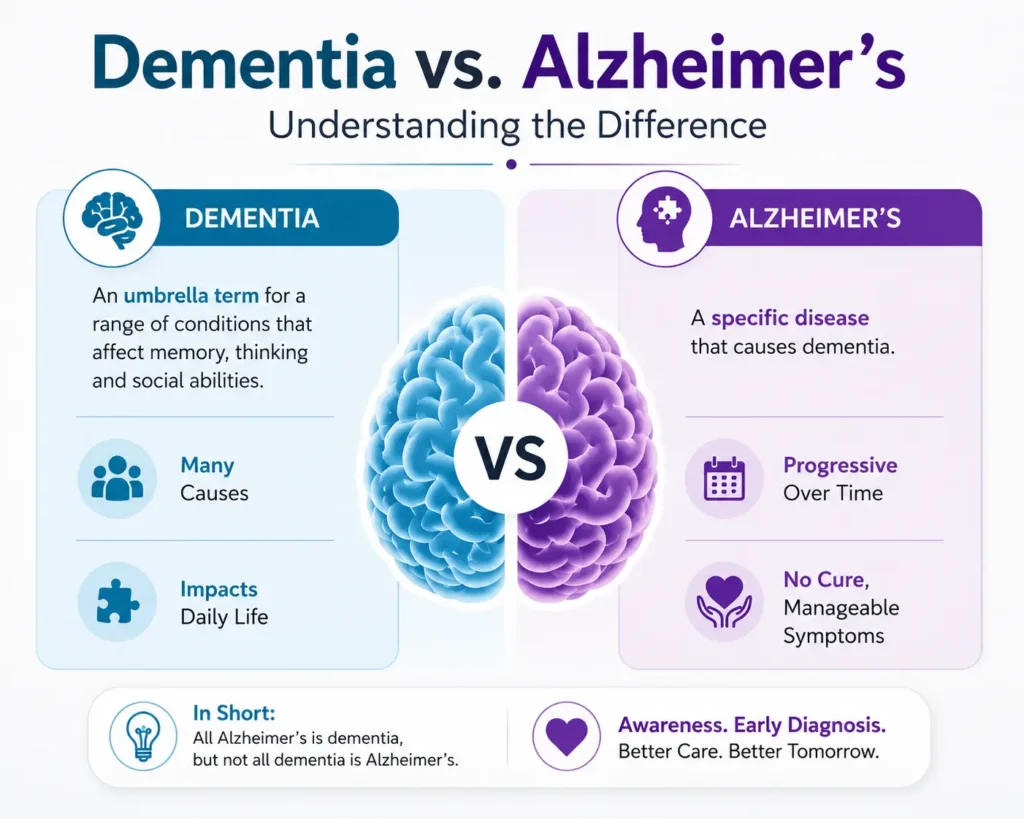
Memory loss is often considered a natural part of ageing, but persistent forgetfulness, confusion, or difficulty performing everyday activities should never be ignored. These symptoms may indicate an underlying neurological condition such as dementia or Alzheimer’s disease. Although the two terms are frequently used interchangeably, they do not mean the same thing.
Understanding the difference between dementia and Alzheimer’s disease is important because it helps patients and families recognise symptoms early, seek timely medical care, and plan appropriate treatment. While some causes of dementia can be managed or even reversed, Alzheimer’s disease is a progressive neurological disorder that requires long-term care and support.
At Solaris Hospital, our experienced neurologists provide comprehensive evaluation, advanced diagnostic services, and personalised treatment plans for patients experiencing memory problems and cognitive decline. Early diagnosis can significantly improve quality of life and help families prepare for the future.
Dementia is not a single disease. Instead, it is an umbrella term used to describe a group of symptoms that affect memory, thinking, reasoning, communication, and the ability to perform daily activities independently.
A person with dementia may struggle to remember recent events, solve problems, make decisions, or recognise familiar people and places. These symptoms gradually interfere with work, social interactions, and everyday life.
Dementia occurs when brain cells become damaged, preventing them from communicating effectively. The condition can result from several different diseases and medical conditions, with Alzheimer’s disease being the most common cause.
Alzheimer’s disease is a specific brain disorder and the leading cause of dementia worldwide. It accounts for approximately 60–80% of dementia cases.
In Alzheimer’s disease, abnormal protein deposits known as amyloid plaques and tau tangles accumulate in the brain. These changes gradually damage nerve cells, affecting memory, language, learning, and behaviour.
The disease usually develops slowly and progresses over several years. Initially, individuals may notice mild forgetfulness, but as the condition advances, they may require assistance with daily activities such as dressing, eating, and personal care.
Simply put, all Alzheimer’s disease causes dementia, but not all dementia is Alzheimer’s disease.
The easiest way to understand the distinction is to think of dementia as a category and Alzheimer’s disease as one type within that category.
Dementia describes the symptoms of cognitive decline, while Alzheimer’s disease refers to the underlying medical condition causing those symptoms. Other conditions, including vascular dementia, Lewy body dementia, and frontotemporal dementia, can also lead to dementia.
This distinction is important because different types of dementia have different causes, progression patterns, and treatment approaches. Accurate diagnosis helps doctors recommend the most appropriate management plan.
Although Alzheimer’s disease is the most common form, several other types of dementia exist.
Vascular dementia develops due to reduced blood flow to the brain, often following strokes or long-standing uncontrolled hypertension.
Lewy body dementia is associated with abnormal protein deposits in the brain and commonly causes fluctuations in attention, visual hallucinations, and movement problems similar to Parkinson’s disease.
Frontotemporal dementia primarily affects the frontal and temporal lobes of the brain, leading to significant changes in personality, behaviour, and language before memory problems become prominent.
In some cases, dementia symptoms may result from treatable conditions such as vitamin deficiencies, thyroid disorders, infections, medication side effects, or normal pressure hydrocephalus. This is one of the reasons why early neurological assessment is so important.
The symptoms of dementia vary depending on its underlying cause, but early warning signs often include gradual changes in thinking and behaviour.
A person may repeatedly forget recently learned information, ask the same questions multiple times, or misplace everyday objects. They may struggle to follow conversations, complete familiar tasks, or manage finances that were once routine.
As dementia progresses, individuals may become confused about dates, lose their sense of direction, or experience changes in mood and personality. Some people withdraw from social activities because they find communication increasingly difficult.
These symptoms typically develop gradually rather than appearing suddenly.
The earliest symptom of Alzheimer’s disease is usually difficulty remembering newly learned information. This occurs because the disease initially affects areas of the brain responsible for forming new memories.
Over time, individuals may have difficulty recalling appointments, conversations, or names of familiar people. They may repeat stories, misplace belongings frequently, or rely heavily on written reminders.
As Alzheimer’s disease advances, language problems, impaired judgement, confusion, behavioural changes, and loss of independence become more noticeable.
Although memory loss is a hallmark of Alzheimer’s disease, every individual experiences the condition differently.
Dementia has many possible causes. Alzheimer’s disease, vascular disease, Parkinson’s disease, traumatic brain injury, infections, and certain neurological disorders can all damage brain cells and lead to cognitive decline.
Risk factors include increasing age, family history, high blood pressure, diabetes, smoking, obesity, lack of physical activity, high cholesterol, excessive alcohol consumption, and cardiovascular disease.
Researchers continue to study the exact mechanisms behind Alzheimer’s disease, but age remains its strongest known risk factor.
Diagnosing dementia involves identifying both the cognitive symptoms and their underlying cause.
At Solaris Hospital, neurologists begin with a detailed medical history and neurological examination. Family members often provide valuable information about behavioural and memory changes that the patient may not recognise.
Diagnosis may include cognitive assessment tests, blood investigations to rule out reversible causes, and brain imaging such as MRI or CT scans. In selected cases, advanced imaging or specialised neurological testing may also be recommended.
An accurate diagnosis is essential because treatment varies depending on the specific type of dementia.
Although there is currently no cure for Alzheimer’s disease, early diagnosis allows doctors to prescribe medications that may help slow symptom progression and improve quality of life.
Treatment also includes cognitive rehabilitation, memory exercises, nutritional support, physical activity, management of associated medical conditions, and emotional support for both patients and caregivers.
Some forms of dementia caused by vitamin deficiencies, infections, medication side effects, or thyroid disorders may improve significantly once the underlying condition is treated.
Comprehensive care focuses not only on medical treatment but also on helping individuals maintain independence for as long as possible.
Many families assume memory problems are simply a normal part of ageing, but persistent cognitive changes should always be evaluated.
You should consult a neurologist if you or a loved one experiences ongoing memory loss, confusion, difficulty performing familiar tasks, changes in personality, problems with speech, poor judgement, or increasing difficulty managing daily activities.
Early neurological evaluation can identify potentially treatable conditions and provide timely intervention before symptoms become more severe.
At Solaris Hospital, our Neurology department provides comprehensive evaluation and treatment for patients with memory disorders and cognitive decline. Using advanced diagnostic technology and evidence-based treatment approaches, our experienced neurologists work closely with patients and their families to develop personalised care plans.
From early diagnosis and medication management to rehabilitation and caregiver guidance, our multidisciplinary team is committed to improving the quality of life for individuals living with dementia and Alzheimer’s disease.
Understanding the distinction between dementia and Alzheimer’s disease is essential for recognising symptoms early and seeking appropriate medical care. While dementia describes a collection of symptoms affecting memory, thinking, and daily functioning, Alzheimer’s disease is the most common neurological condition responsible for those symptoms. Early diagnosis allows timely treatment, better symptom management, and improved planning for the future.
If you or a loved one has persistent memory loss, confusion, or changes in behaviour, don’t dismiss these signs as a normal part of ageing. The experienced neurologists at Solaris Hospital provide comprehensive assessment, accurate diagnosis, and personalised treatment plans to help patients maintain independence and quality of life for as long as possible. Early intervention can make a meaningful difference in managing cognitive health.
Solaris Hospital, Thane
📍 Address: Service Road, Ghodbunder Rd, next to AP Shah Institute of Technology, Kasarvadavali, Thane West, Maharashtra 400615
📞 Phone: 086556 96500
🌐 Website: https://solarishospitals.com/
No. Dementia is a general term describing a decline in memory and thinking abilities, while Alzheimer’s disease is the most common cause of dementia.
Some causes of dementia-like symptoms, such as vitamin deficiencies, thyroid disorders, or infections, may improve with treatment. Most progressive dementias, including Alzheimer’s disease, cannot currently be reversed but can often be managed.
The earliest symptom is usually difficulty remembering recently learned information or recent events.
No. Memory loss can occur due to stress, depression, medication side effects, sleep disorders, or normal ageing. A neurological evaluation is necessary to determine the underlying cause.
Most cases develop after the age of 65, although early-onset Alzheimer’s disease can occur in younger individuals.
Service Road, Ghodbunder Rd, next to AP Shah Institute of Technology, Kasarvadavali, Thane West, Maharashtra 400615
Pioneering Excellence in Neurology and Neurosurgery with Cutting-Edge Technology and Compassionate Care. Solaris Hospital is your one-stop destination for comprehensive with wide range of multi-specialty services.
Service Road, Ghodbunder Rd,
next to AP Shah Institute of
Technology, Kasarvadavali,
Thane (West),
Maharashtra. 400615
Phone:+91 22 4004 4001 / 4004 4003 / 8655696500
E-mail:contact@solarishospitals.com