Chest pain is one of the most alarming symptoms a person can experience. While many episodes of chest discomfort are caused by harmless digestive issues such as gas or acid reflux, similar symptoms can also signal a heart attack, a medical emergency that requires immediate treatment. Because the symptoms often overlap, many people struggle to distinguish between the two, sometimes delaying life-saving care.
Understanding the difference between gas pain and heart attack is essential. Although gas pain is generally temporary and improves with simple measures, heart attack pain results from reduced blood flow to the heart and can rapidly become life-threatening if left untreated. Knowing the warning signs can help you seek the right medical attention without delay.
At Solaris Hospital, our experienced cardiologists and emergency medicine specialists provide prompt evaluation and advanced cardiac care for patients experiencing chest pain, helping ensure timely diagnosis and treatment.
Gas pain occurs when excess gas becomes trapped in the stomach or intestines. It commonly develops after eating too quickly, consuming carbonated beverages, eating gas-producing foods, swallowing excess air, or due to digestive disorders such as acid reflux or irritable bowel syndrome.
The discomfort may range from mild bloating to sharp or cramping pain. Because the stomach lies close to the heart, gas pain can sometimes be felt in the upper abdomen or chest, leading people to mistake it for a heart-related problem.
Fortunately, gas pain usually improves after passing gas, burping, changing body position, or taking medications recommended by a healthcare provider.
A heart attack, also known as a myocardial infarction, occurs when blood flow to a part of the heart muscle becomes blocked, most commonly due to a blood clot forming over a narrowed coronary artery. Without adequate oxygen, the affected heart muscle begins to suffer damage.
Unlike gas pain, a heart attack requires immediate emergency medical treatment. Delaying care can increase the amount of heart muscle damage and lead to serious complications such as heart failure, dangerous heart rhythm disturbances, or even death.
Recognising the symptoms early and seeking urgent medical attention can significantly improve survival and recovery.
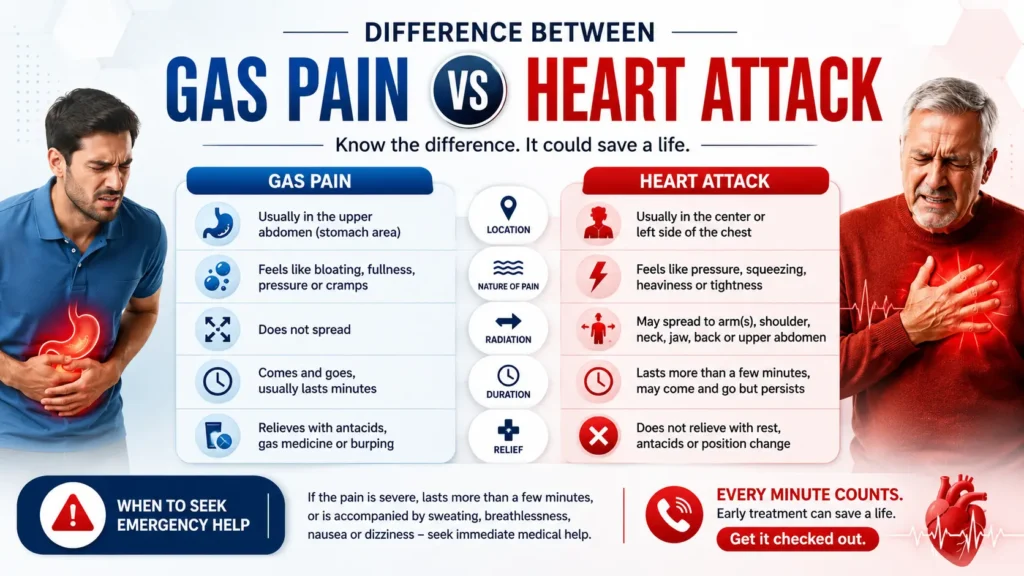
Although both conditions may cause discomfort in the chest, they differ in several important ways.
Gas pain often develops after eating a heavy meal, consuming spicy or fatty foods, or drinking carbonated beverages. The pain is usually sharp, cramp-like, or associated with bloating and tends to move around the abdomen or chest. Many people experience relief after burping, passing gas, or changing their posture.
Heart attack pain, on the other hand, is typically described as pressure, heaviness, squeezing, or tightness in the centre or left side of the chest. Rather than improving with movement or digestion, the discomfort usually persists and may gradually worsen. The pain often spreads to the left arm, shoulder, neck, jaw, or back.
Another important difference is that heart attacks are frequently accompanied by other symptoms such as sweating, shortness of breath, nausea, dizziness, or an overwhelming sense that something is seriously wrong. Gas pain rarely causes these symptoms.
Gas pain is usually related to digestion and often occurs after meals. Common symptoms include:
• Bloating or abdominal fullness
• Burping or belching
• Passing excessive gas
• Sharp or cramping pain in the upper abdomen or chest
• Symptoms that improve after passing gas
• Mild nausea or indigestion
While uncomfortable, these symptoms generally improve within a short period and are not usually associated with severe illness.
Heart attack symptoms can vary from person to person, and not everyone experiences severe chest pain. Some individuals, particularly women, older adults, and people with diabetes, may have more subtle symptoms.
Warning signs include:
• Pressure, tightness, or heaviness in the chest
• Pain spreading to the arm, shoulder, neck, jaw, or back
• Shortness of breath
• Cold sweats
• Nausea or vomiting
• Dizziness or light-headedness
• Unusual fatigue
• Chest discomfort lasting more than a few minutes or recurring repeatedly
These symptoms should never be ignored, even if they seem mild.
Yes. One reason heart attacks are sometimes mistaken for gas pain is that they can produce symptoms resembling indigestion or acidity.
Some people experience burning in the chest, upper abdominal discomfort, nausea, or a sensation of fullness rather than the classic crushing chest pain. This is especially common in women and older adults. Because of this overlap, it is always safer to seek emergency medical evaluation if you are unsure of the cause of persistent chest pain.
Understanding your personal risk factors can help determine whether chest pain requires urgent evaluation.
People with high blood pressure, diabetes, high cholesterol, obesity, smoking habits, a family history of heart disease, chronic kidney disease, or a sedentary lifestyle have a greater risk of developing coronary artery disease and heart attacks.
Age is another important factor, although heart attacks can occur in younger individuals as well, particularly when multiple risk factors are present.
It can be difficult to determine the exact cause of chest pain without medical evaluation. If there is any doubt, it is always safest to assume the possibility of a heart attack until proven otherwise.
Seek emergency medical attention immediately if you experience:
• Chest pain lasting more than a few minutes
• Pain that spreads to the arm, jaw, shoulder, or back
• Difficulty breathing
• Cold sweats
• Sudden dizziness or fainting
• Severe nausea accompanied by chest discomfort
• Chest pain during physical activity or emotional stress
• Symptoms that do not improve with rest
Never attempt to diagnose a heart attack at home based solely on symptoms.
When a patient arrives with chest pain, doctors first focus on ruling out life-threatening conditions.
A detailed medical history and physical examination are followed by investigations such as an electrocardiogram (ECG), blood tests to detect cardiac enzymes, continuous heart monitoring, and, if required, imaging studies. If these tests exclude a heart problem, further evaluation may focus on digestive conditions such as acid reflux, gastritis, or excess gas.
Early testing is essential because prompt treatment can significantly reduce heart damage in the event of a heart attack.
Treatment depends entirely on the underlying cause.
Gas pain is usually managed with dietary modifications, adequate hydration, medications to reduce gas or acidity when appropriate, and treatment of any underlying digestive disorders.
A heart attack requires emergency treatment, which may include medications to restore blood flow, angioplasty with stent placement, or other advanced cardiac interventions. Early treatment greatly improves the chances of recovery and reduces long-term complications.
At Solaris Hospital, we understand that every episode of chest pain deserves careful evaluation. Our emergency department is equipped with advanced diagnostic facilities and supported by experienced cardiologists who provide rapid assessment and evidence-based treatment for heart-related emergencies.
From emergency cardiac care and advanced imaging to comprehensive heart health management, our multidisciplinary team is committed to delivering timely, compassionate, and high-quality care when every minute matters.
Solaris Hospital, Thane
📍 Address: Service Road, Ghodbunder Rd, next to AP Shah Institute of Technology, Kasarvadavali, Thane West, Maharashtra 400615
📞 Phone: 086556 96500
🌐 Website: https://solarishospitals.com/
Gas pain can sometimes mimic heart attack symptoms, particularly when it causes discomfort in the upper abdomen or chest. However, persistent chest pain should always be evaluated by a healthcare professional.
Yes. Some people, especially women, older adults, and individuals with diabetes, may experience symptoms such as shortness of breath, fatigue, nausea, or upper abdominal discomfort instead of severe chest pain.
Yes. If you cannot confidently identify the cause of chest pain or if it is accompanied by symptoms such as sweating, breathlessness, or pain spreading to the arm or jaw, seek emergency medical care immediately.
No. Acidity itself does not cause a heart attack, but because its symptoms can resemble those of a heart attack, proper medical evaluation is important to determine the actual cause.
Service Road, Ghodbunder Rd, next to AP Shah Institute of Technology, Kasarvadavali, Thane West, Maharashtra 400615
Pioneering Excellence in Neurology and Neurosurgery with Cutting-Edge Technology and Compassionate Care. Solaris Hospital is your one-stop destination for comprehensive with wide range of multi-specialty services.
Service Road, Ghodbunder Rd,
next to AP Shah Institute of
Technology, Kasarvadavali,
Thane (West),
Maharashtra. 400615
Phone:+91 22 4004 4001 / 4004 4003 / 8655696500
E-mail:contact@solarishospitals.com